
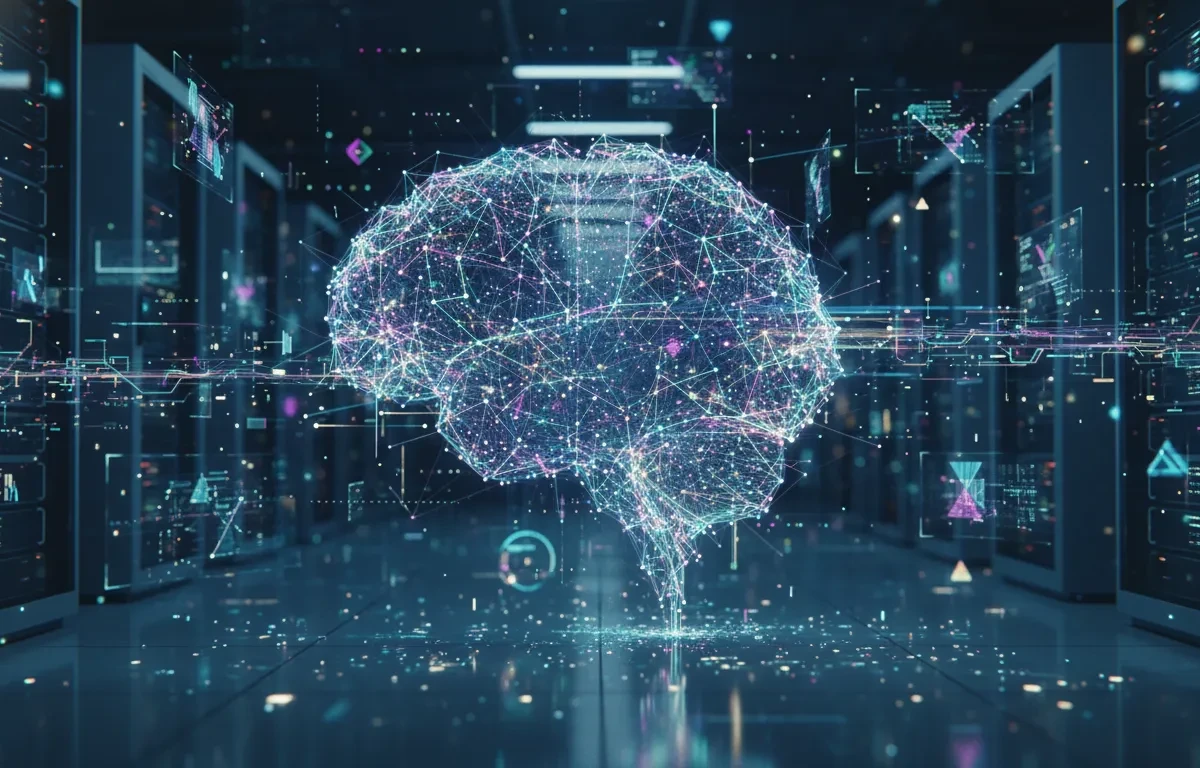
Have you ever wondered how artificial intelligence manages to learn and make complex decisions? Behind many of today’s most striking technological breakthroughs—from facial recognition to self-driving cars—lies a fascinating concept: neural networks.
At Tech by Tehub, we’re here to demystify this universe. In this article, we’ll dive deep into what neural networks are, how they function, and why they are so vital to the future of tech. Our goal is to make this knowledge accessible to everyone, from curious newcomers to dedicated tech enthusiasts.
What Are Neural Networks and How They Mimic the Brain
Think of neural networks as the digital nervous system of modern artificial intelligence. They are directly inspired by biology, designed to replicate the way the human brain processes information and arrives at decisions.
In our own brains, billions of neurons connect to transmit electrical and chemical signals, allowing us to learn and recognize patterns. Artificial neural networks function in a similar fashion, using algorithms and mathematics to simulate this complex behavior.
It all begins with the fundamental unit: the artificial neuron, also known as a perceptron. These tiny components receive data, process it, and decide whether to pass the signal along.
To make this work, we organize these neurons into three primary types of layers:
- Input Layer: Where raw data (such as the pixels of a photograph) enters the system.
- Hidden Layers: The “heart” of the operation, where correlations and patterns are identified.
- Output Layer: Where the network delivers the final result, such as a classification or a prediction.
We call this arrangement Deep Learning, as these networks can consist of hundreds of hidden layers. The more layers and connections a network has, the greater its capacity to tackle complex problems.
The real breakthrough is that we don’t program rigid, step-by-step rules for the machine to follow. Instead, we allow the network to discover the rules on its own by observing massive volumes of data. It is this capacity for self-adjustment that makes neural networks so powerful and revolutionary in today’s technological landscape.
How Neural Networks Work in Practice

To understand how the magic happens, we need to look at the training process of a neural network. We begin with a stage called feedforward. In this step, data travels from the input to the output, passing through connections that have different weights.
Think of weights as volume knobs—they determine how much importance each piece of information carries toward the final result. If the network is trying to identify a cat, it analyzes edges, colors, and shapes, assigning “weight” to each detail. Alongside weights, we have biases, which act as a flexible offset, helping the network fine-tune its decision-making.
After processing, the network generates an answer. At first, it usually gets it wrong—often by a lot. This is where the most vital part of learning comes in: backpropagation.
We calculate the difference between the network’s guess and the correct answer, creating what we call a loss function. The algorithm then works backward, adjusting the weights and biases to reduce the error on the next try. This cycle repeats thousands or millions of times until the network achieves incredible precision.
To decide if a neuron should “fire,” we use activation functions, such as ReLU or Sigmoid. These act as mathematical filters that determine if the information is relevant enough to be passed along. Over time, the network builds an internal representation of knowledge, allowing it to generalize its learning to brand-new data.
Types of Neural Networks and Their Modern Applications
We don’t use a “one-size-fits-all” model; specific architectures exist for every need. Below, we’ve broken down the primary variations shaping our digital daily lives:
| Network Type | Acronym | Primary Application | Real-World Example |
| Multilayer Perceptron | MLP | Tabular data & simple classification | Spreadsheet sales forecasting |
| Convolutional | CNN | Image & video processing | FaceID/Mobile facial recognition |
| Recurrent | RNN | Sequential data & time series | Speech recognition & translation |
| Transformers | — | Natural Language Processing (NLP) | ChatGPT & writing assistants |
Convolutional Neural Networks (CNNs) are the specialists of computer vision. They “scan” images piece by piece, identifying visual patterns like textures and contours. On the other hand, Recurrent Neural Networks (RNNs) possess a kind of “short-term memory.” This makes them ideal for understanding the context of a sentence, where word order changes the entire meaning.
We see these technologies in action when Netflix suggests a movie or when Waze calculates the fastest route. In medicine, neural networks help doctors diagnose diseases from medical scans with superhuman accuracy. In finance, they are fundamental for detecting credit card fraud in milliseconds.
The versatility of these structures allows them to be applied to almost any field involving massive volumes of data. We are only scratching the surface of what is possible with these different—arquiteturas.
The Future of Neural Networks and the Next Frontier of AI

As we look toward the horizon, it’s clear that neural networks are becoming increasingly efficient and autonomous. The future holds significant breakthroughs in unsupervised learning, meaning AI will require far less human intervention and fewer labeled datasets to grasp new concepts.
We are also moving toward Multimodal AI, where a single neural network can simultaneously process text, audio, and video. This integration will pave the way for much more natural, human-like interactions between us and our machines.
However, this rapid growth brings ethical challenges we cannot afford to ignore. The issue of algorithmic bias is central: if the training data is biased, the network will be too. We must work toward more transparent and explainable models, actively tackling the “black box” problem.
Another powerful trend is Edge AI, where neural networks run directly on small devices like smartwatches and sensors. This ensures greater privacy and speed, as data doesn’t need to travel to the cloud for processing. Sustainability is also a key focus, with a push for networks that consume less energy and fewer computational resources.
We believe that neural networks will be the cornerstone for building smart cities and finding cures for complex diseases. Technological innovation will continue to be driven by our ability to refine these digital minds. The future is collaborative—a world where human and artificial intelligence work hand-in-hand to solve humanity’s greatest challenges.
Did you enjoy uncovering the mysteries of Neural Networks with us? Technology is evolving at a breathtaking pace, and we want you to be part of this journey! Leave a comment below sharing which AI application surprises you the most, or share this article with that friend who loves understanding how the future is being built. Let’s keep the conversation going!
The Legacy of Neural Networks in the Tech World
We’ve reached the end of our journey through the fascinating world of neural networks. We hope you now have a clear understanding of how these brain-inspired structures are revolutionizing artificial intelligence—from pattern recognition to complex decision-making. It’s incredible to think about the impact they already have and the even greater role they will play in our daily lives!
At Tech by Tehub, we are true enthusiasts of this future. Which application of neural networks impressed you the most? Drop a comment below, share this article with fellow tech lovers, and keep exploring the next big breakthroughs with us!
FAQ — Common Questions About Neural Networks
We have prepared this section to address the most frequently asked questions regarding the inner workings of neural networks and their impact on our everyday lives.
While traditional AI relies on rigid, human-programmed rules, neural networks learn to identify patterns on their own through massive volumes of data. We use them specifically to solve complex problems where clear, step-by-step instructions don’t exist—such as speech recognition.
No, because the fundamental concept is understanding how they mimic the human brain to process information in layers. Although the technical construction involves complex calculations, we can grasp their logic as a system of trial, error, and the constant adjustment of connections.
They use a process called backpropagation, which adjusts the weights of internal connections whenever the final result is incorrect. Through time and exhaustive repetition, the network refines these internal calculations so that its predictions become increasingly accurate.
We interact with them constantly, from personalized recommendations on streaming services to voice assistants and spam filters. They are also the engine behind smartphone facial recognition and automatic text translations.
Although they are inspired by our biology and outperform humans in specific data-processing tasks, they still lack consciousness and emotions. The future we envision is one of collaboration, where this technology amplifies our capabilities without replacing the essence of human creativity.


Deixe um comentário