
Imagine a internet where everything happens in the blink of an eye. That's what technology fifth generation promises.
A speed 5G networks can reach up to 10 gigabits per second, allowing you to download in seconds.
But 5G technology It's not just about speed; it's about creating new possibilities for different sectors and improving your day-to-day life.
Are you ready to discover how this revolution can impact your life?
All about 5G Technology: What It Is and How It Works
You're about to discover how 5G technology will revolutionize your mobile experience. The new generation of mobile networks promises wider and more efficient coverage, as well as greater data transfers and a significantly higher number of simultaneous connections.
Definition and Basic Concept
5G technology is the fifth generation of mobile networks, designed to provide extremely fast data speeds and near-zero latency.
5G networks are capable of delivering speeds up to 100 times faster than 4G networksIt can reach up to 10 Gbps.
This means you can enjoy a much faster and more efficient mobile internet experience. What's more, latency reduced to less than 5 ms makes applications that require almost instantaneous responses possible.
Differences between 5G and Previous Generations
When you compare 5G with previous generations of mobile networks, you'll notice striking differences, especially in terms of speed and capacity.
- Average speeds of 33 Mbps on 4G versus speeds up to 100 times higher on 5G, reaching an incredible 10 Gbps.
- Latency reduced from 30 ms in 4G to less than 5 ms in 5G, allowing applications that require fast responses.
- Much greater connection capacity, allowing more devices to connect simultaneously.
These improvements mean that you will experience more fluid and efficient connectivity with 5G. In addition, energy efficiency and connection stability are also significantly improved.
5G technology represents a great leap forward in terms of generations of mobile networks, offering a much more advanced mobile experience capable of supporting a wide range of innovative applications.
The Evolution of Mobile Networks up to 5G
The journey to 5G has been a long one, passing through several generations of mobile technology. From the first step with 1G technology to the revolution we are experiencing with 5G, each generation has brought significant advances.
A Brief History: From 1G to 4G
The first generation of mobile networks, 1G, was launched in the 1980s, offering voice communication. Over time, we evolved to 2G, which brought the ability to send text messages (SMS).
3G, on the other hand, allowed internet browsing, albeit at modest speeds.
The leap to 4G represented a substantial improvement, with significantly faster data speeds, facilitating video streaming and other data-intensive applications.
Each generation has seen an improvement in capacity and speed networks. However, 4G began to show limitations with the exponential increase in the number of connected devices and the demand for greater bandwidth.
The technological leap to 5G
5G represents a technological leap unprecedented, not just an incremental evolution. With 5G, you will experience download speeds which can reach up to 10 gigabits per second (Gbit/s), allowing you to download entire movies in seconds.
In addition connection capacity increases exponentially, supporting up to 1 million devices per square kilometer, compared to just 100,000 in 4G.
- The ultra-low latency 5G (less than 5 milliseconds) creates possibilities for applications that require instantaneous responses, such as remote surgeries and autonomous vehicles.
- 5G doesn't just improve what already exists; it allows new applications and services to emerge that were technically impossible with previous generations.
By understanding this evolution, it becomes clear that 5G is not just an improvement on technology but a door to a future full of innovations and new possibilities.

How 5G Technology Works
5G is more than just a mobile network upgrade; it's a revolution in the way we connect.
With significantly faster download speeds and almost non-existent latency, 5G is transforming the way you experience mobile internet.
Infrastructure and Antennas
The 5G infrastructure includes a network of advanced antennas that are crucial to its operation. Large devices using the multiple-input multiple-output (MIMO) method were deployed for 4G use as early as 2016 and typically used 32 to 128 small antennas on each cell.
These antennas work together to increase performance by 4 to 10 times. Massive MIMO technology is one of the main features of 5GThis allows several streams of data bits to be transmitted simultaneously.
Frequency spectrum used
5G operates in a variety of frequency spectrums, from low-frequency bands to high-frequency millimeter waves.
The use of millimeter waves allows for extremely fast data speedsbut require a clear line of sight between the antenna and the device. Lower frequency bands offer wider coverage, but more modest speeds.
Data Transmission Technologies
5G uses several advanced data transmission technologies to maximize efficiency. In addition to massive MIMO beamforming is a technique that directs concentrated beams of radio waves directly to your device, instead of dispersing the signal in all directions.
This results in a more stable and faster connection. To find out more about how these technologies are being implemented, you can visit this article which explores the future of the internet with 5G.
- 5G technology uses advanced data transmission technologies which are revolutionizing the way information travels between the network and its devices.
- Beamforming is a sophisticated technique that directs concentrated beams of radio waves directly at your device.
- Advanced modulation allows more data to be transmitted on each radio wave, maximizing the efficiency of the available spectrum.
These technologies work together to create a much faster, more stable and efficient connection experience than was possible with previous generations.
Main Features and Advantages of 5G
With the arrival of 5G, you will experience a new era of connectivity and speed. This technology not only improves the user experience, but also paves the way for innovative new applications and services.
Transfer Speed and Capacity
The data transfer speed of 5G is significantly faster than previous generations. You'll enjoy faster downloads and a smoother streaming experience.
Transfer fees: Up to 20 Gbps
Low Latency and Response Time
A latência reduzida do 5G melhora a responsividade em aplicações críticas. Isso é especialmente benéfico para jogos online e aplicações de realidade virtual.
- Latency: Less than 1 ms
- Faster response time
Higher Density of Connections
5G supports a much higher density of connections, allowing more devices to connect to the network simultaneously. This is crucial for the development of smart cities and IoT.
| Technology | Connection density |
|---|---|
| 4G | 100,000 devices/km² |
| 5G | 1,000,000 devices/km² |
Energy Efficiency
Energy efficiency is one of the outstanding features of 5G. 5G networks are designed to consume up to 90% less energy than 4G networks to transmit the same volume of data.

"5G technology not only improves data transfer speed and capacity, but is also more energy efficient."
With these characteristics, 5G not only improves the user experience, but also contributes to a more sustainable network infrastructure.
5G Frequency Bands and Their Applications
5G technology operates in different frequency bands, each with its own specific characteristics and applications.
This allows 5G to offer a wide range of services, from high-speed mobile connections to low-latency IoT applications.
Low Frequency Bands
Low-frequency bands, generally below 1 GHz, offer wider coverage due to their ability to penetrate obstacles.
These frequencies are ideal for providing coverage in rural and suburban areas where population density is lower.
Although the speeds are more modest compared to high-frequency bands, they are essential to guarantee the availability of the service over a wide geographical area.
Medium Frequency Bands
The mid-frequency bands, which range from 1 to 6 GHz, represent a balance between coverage and capacity.
They offer higher speeds than low-frequency bands and are suitable for urban and suburban areas.
These frequencies are particularly useful for applications that require a good combination of speed and coverage.
High Frequency Bands (mmWave)
The high frequency bands, also known as millimeter waves (mmWave), operate between 24 and 39 GHz.
They offer the most impressive 5G speeds, reaching several gigabits per second. However, these frequencies have a limited range and face difficulties when crossing obstacles.
They are ideal for areas with high population density, such as shopping centers and stadiums, where the demand for high speed and low latency is critical.
High-frequency bands are essential for applications that require massive data transfer, such as virtual and augmented reality in outdoor environments.
Although they face coverage challenges, their ability to offer extremely high speeds makes them essential for the future of mobile communications.
- High frequency bands (24-39 GHz) offer download speeds in the gigabit per second range.
- They are ideal for densely populated areas such as shopping centers and stadiums.
- The implementation of these bands faces challenges due to their limited reach and difficulty in crossing obstacles.
Impacts of 5G on everyday life
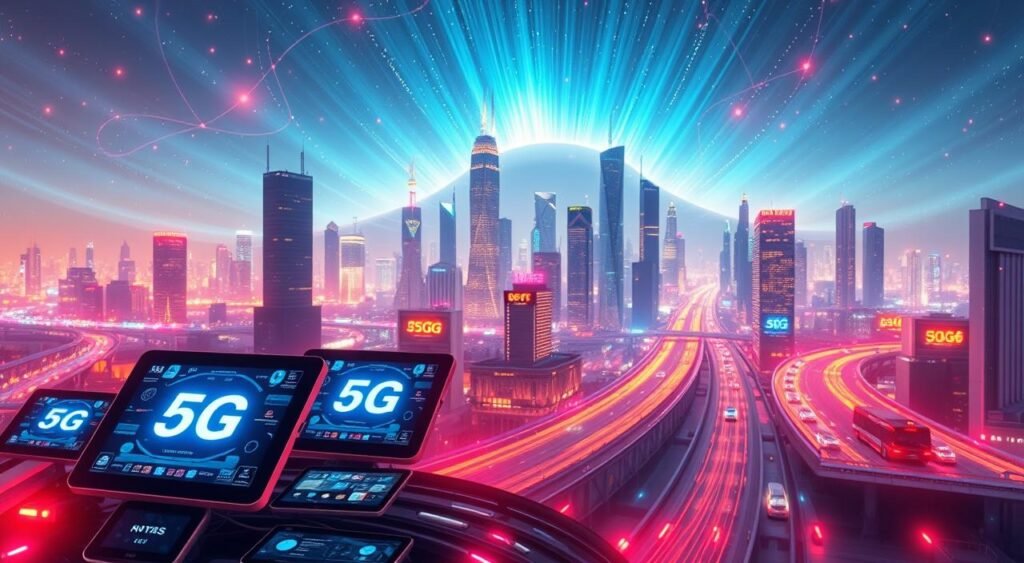
With the arrival of 5G, your daily life is about to change dramatically. The new generation of mobile technology promises to revolutionize the way you interact with devices and the internet.
Transforming the Mobile Internet Experience
The speed and low latency of 5G will transform your mobile internet experience. You'll be able to consume content in 4K and even 8K resolution without worrying about buffering or quality, making high-definition streaming the new standard.
The ultra-fast 5G connection also will allow new forms of interaction online, enriching your browsing experience.
New possibilities for work and entertainment
5G will open up new possibilities for work and entertainment. With high bandwidth and low latency, technologies such as virtual and augmented reality (VR/AR) will become more accessible, enabling immersive experiences in many areas.
- Virtual and augmented reality will be more accessible, enabling new forms of entertainment and work.
- Downloading heavy applications and games will become faster, changing their relationship with local storage.
Changes in Digital Consumption Habits
5G will profoundly change your digital consumption habits. With the ability to transmit large volumes of data, streaming platforms and social networks will evolve to offer more immersive experiences.
You'll consume content in a richer and more interactive way, making the most of 5G's ultra-fast connection.
Internet of Things (IoT) and 5G
With the arrival of 5G, the Internet of Things (IoT) will reach new heights of connectivity, allowing devices to communicate more efficiently and quickly. This will pave the way for many innovative applications that will transform everyday life.
Advanced connectivity
5G technology will provide significant expansion of connectivity between devicesallowing more devices to connect to the internet simultaneously without losing performance.
This is crucial for the IoT, as it will enable everyday objects such as fridges and cars to become "smart" and interact with each other autonomously.
For example, your fridge could be programmed to warn you when it's running low, and with an IoT connection, it could even order the product automatically.
The short latency time of 5G networks will allow security systems, such as cameras and sensors, to work in real time, increasing the security in homes and cities.
Smart Homes and Cities
5G will be the backbone of the smart homes and cities of the future, allowing thousands of devices and sensors to work in harmony.
In your smart home, you'll have appliances that communicate with each other, optimizing daily tasks.
In smart cities, street lighting systems, traffic lights, security cameras and environmental sensors will form an integrated network that improves quality of life.
According to experts, the implementation of 5G will bring innovations such as intelligent traffic management technologies and environmental monitoring, making cities more efficient and sustainable.
| Applications | Benefits |
|---|---|
| Smart Homes | Automation of tasks, greater convenience |
| Smart Cities | Optimization of resources, improvement in quality of life |
| Public Security | Real-time monitoring, crime prevention |
With these changes, the security public will be improved with monitoring systems that use artificial intelligence to identify risk situations.
In short, 5G will not only improve connectivity, but will also transform the way we live and interact with the world around us.
Revolutionary applications of 5G
5G technology is revolutionizing medium in which we live, allowing new forms of interaction and innovation.
With its ability to provide ultra-fast, low-latency connections, 5G is paving the way for a variety of revolutionary applications that promise to transform several sectors.
Autonomous Vehicles and Mobility
One of the most promising areas for 5G is autonomous vehicles. With the low latency and high speed of 5G, vehicles will be able to communicate from shape efficient and safe, enabling the implementation of intelligent and autonomous transportation systems.
Telemedicine and Digital Health
5G is also revolutionizing healthcare with telemedicine. High-speed connections allow health data to be transmitted in real time, facilitating remote diagnoses and surgical procedures.
This significantly improves the accessibility and efficiency of health services.
Virtual and Augmented Reality
A technology 5G is driving the adoption of virtual and augmented reality. With the ability to transmit large volumes of data These technologies are rapidly becoming more viable for entertainment, education and training applications.
Industry 4.0 and Smart Factories
5G is a fundamental pillar of Industry 4.0, enabling the creation of hyper-connected smart factories.
The operators network are playing a crucial role in the implementation of these technologies. With 5G, factories can connect thousands of smart devices, such as cameras and sensors, in order to collect data automatically in real time.
This allows data to be analyzed and processed to improve the efficiency and cost-effectiveness of operations.
- 5G enables flexible automation and rapid adaptation to different manufacturing demands.
- Thousands of connected sensors monitor all aspects of production in real time.
- Predictive maintenance based on real-time data reduces machine downtime.
- Collaborative robots and autonomous vehicles work in coordination within factories.
By integrating these technologies, factories can achieve new levels of productivity and efficiency, completely transforming industrial processes.

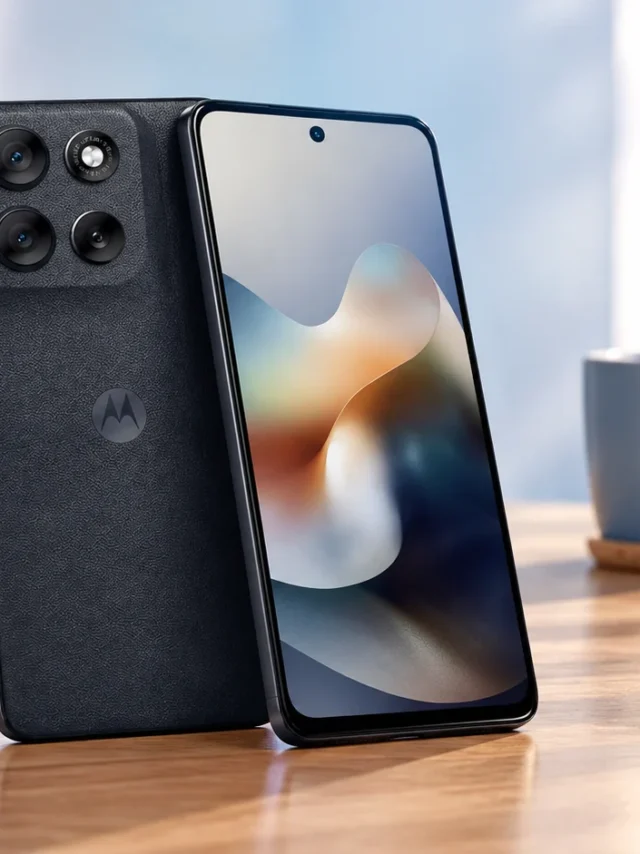
- High-definition beauty and a soft-touch finish.
- Cinema screen with Dolby Atmos sound
- Camera with Artificial Intelligence and Google Photos.
5G implementation in Brazil and around the world
You're about to discover how 5G is being implemented around the world. 5G technology promises to revolutionize the way we connect and interact globally, offering faster data speeds and more reliable connectivity.
Current Status of Global Deployment
The rollout of 5G is underway in many parts of the world. Countries such as the USA, China and South Korea are already at the forefront of this technology, with several operators offering 5G services.
Global coverage is expanding rapidly, with new countries joining the list of adopters every month.
Prospects for Brazil
In Brazil, the implementation of 5G is also underway. Major telecommunications operators are investing heavily in the infrastructure needed to support 5G technology.
In addition, it plans to invest R$ 1 billion to add a new assembly line dedicated to fifth-generation technology for its operations in Latin America.
This promises to significantly improve the coverage and quality of telecommunications services in the country.
Infrastructure challenges
The implementation of 5G faces several infrastructure challenges. Many antennas need to be installed, especially for the high-frequency bands, which require smaller cells.
In addition, the backhaul needs to be upgraded to high-capacity optical fiber to support the volume of data.
In large cities, the installation of thousands of small antennas requires adaptations to municipal legislation.
In rural and remote areas, infrastructure development represents an even greater challenge, requiring creative solutions to enable universal coverage.
5G-compatible devices
5G-compatible devices are transforming the user experience. With 5G technology, you can expect faster and more stable connectivity on a wide range of devices.
Smartphones and Tablets
Smartphones and tablets are the most obvious devices for adopting 5G. With the ability to offer significantly faster download speeds, these devices allow you to enjoy high-definition content without interruptions.
In addition, 5G's low latency improves the experience of online games and augmented reality applications.
Other devices and equipment
In addition to smartphones and tablets, a wide range of devices and equipment are appearing on the market with 5G support. This includes:
- Routers and 5G modems for residential and business use, offering high-speed internet without the need for physical connections.
- Devices Internet of Things (IoT) with 5G connectivity, revolutionizing sectors such as agriculture, logistics and manufacturing with real-time monitoring.
- Wearables such as smartwatches and smart glasses, which are incorporating 5G connectivity to offer advanced functionalities.
- Connected vehicles, from cars to drones, that use 5G networks for communication and navigation.
A 5G technology is paving the way for new possibilities in various sectors. To find out more about how 5G is revolutionizing the internet, visit this article.
| Device type | Application | Benefits of 5G |
|---|---|---|
| Smartphones and Tablets | Personal and professional use | Faster download speeds |
| 5G Routers and Modems | Residential and business use | High-speed wireless connection |
| IoT devices | Agriculture, logistics, manufacturing | Real-time monitoring |
Challenges and Limitations of 5G Technology
As 5G technology expands, several challenges arise, impacting its implementation and adoption.
Although 5G promises to revolutionize the way we connect and interact with technology, there are significant obstacles that need to be overcome for its potential to be fully realized.
Signal Coverage and Range
One of the main challenges of 5G is coverage and signal range. 5G networks operate at higher frequencies, which means they have a shorter range and are more easily blocked by physical obstacles.
This requires denser antenna infrastructure to ensure adequate coverage, especially in dense urban areas.
Implementation costs
The costs of implementing 5G are another significant challenge. It is estimated that, in Europe, the costs of installing the new antenna infrastructure will amount to between 300 and 500 billion euros, a very large investment for even greater potential.
These high costs can be an obstacle to the rapid adoption of 5G, especially in less developed regions.
Security and privacy issues
Security and privacy represent critical challenges for 5G networks. With the exponential increase in connected devices, the protection of personal data becomes even more crucial.
In addition, the distributed architecture of 5G, with processing at the edge of the network, creates new attack vectors that require innovative security approaches.
The transmissions of 5G radioAlthough more secure than previous generations, they can still be vulnerable to sophisticated interception without the proper protection measures.
- Security and privacy are critical challenges for 5G networks.
- The distributed architecture of 5G creates new attack vectors.
- The protection of personal data is crucial with 5G.
In addition, geopolitical issues related to 5G equipment suppliers also raise concerns about national security and espionage in many countries.
It is therefore essential to address these challenges proactively to ensure that the benefits of 5G are fully realized.
The Future with 5G and Beyond
As 5G continues its global expansion, researchers are already envisioning the future with the sixth generation of mobile networks, 6G.
Communication technologies are constantly evolving, and the transition to 6G promises to further revolutionize our relationship with technology.
Next Steps in the Evolution of Technology
The implementation of 5G is still underway, but experts are already starting work on the development of 6G. 6G is expected to offer theoretical speeds of up to 1 terabit per secondabout 100 times faster than 5G.
This will open up new possibilities for holographic communication and sensory internetand fundamentally transforming how we interact with technology.
6G networks will probably operate at even higher frequencies, possibly in the terahertz range.
This will bring new challenges, but will also pave the way for significant advances in areas such as artificial intelligence and distributed processing capacity.
| Technology | Speed | Applications |
|---|---|---|
| 5G | Up to 10 Gbps | Advanced mobile internet, IoT |
| 6G | Up to 1 Tbps | Comunicação holográfica, internet sensorial, integração com IA |
Preparing for 6G
While 5G is still establishing itself, researchers are working on the foundations of 6G. Technologies such as holographic communication e direct integration with neural systems are on the horizon of possibilities.
Distributed processing capacity and integration with artificial intelligence will be fundamental for 6G, allowing the network to adapt dynamically to needs.
The potential of 6G goes far beyond human communication, creating a symbiosis between the physical and digital worlds. This will fundamentally transform how we interact with technology, opening up new possibilities for the future.
Conclusion
The implementation of 5G promises to fundamentally change your relationship with technology and the digital world.
5G technology represents much more than just an incremental advance in telecommunications; it is a revolution that will transform your daily life in unimaginable ways.
You will experience not only impressive internet speedsbut a whole new dimension of possibilities that will change the way you work, play and connect.
The impact of 5G will be felt in virtually every sector of the economy and aspect of everyday life, from health and education to transportation and entertainment.
Although there are significant challenges for its full implementation, the potential benefits of 5G justify the massive investments being made globally.
As technology matures and becomes more accessible, we will see a accelerating innovation and the emergence of applications that we can barely imagine today.
5G is not just about faster connections, but about creating a smarter, more efficient and connected world that will benefit everyone.
We are only at the beginning of this transformative journey, and the next few years will reveal all the revolutionary potential that 5G has to offer.
With your advanced technology and the ability to improve connection and speed of the Internet, the future with 5G is extremely promising.
FAQ
Q: What is 5G technology?
A: 5G technology is the fifth generation of mobile networks, designed to provide faster data speeds, lower latency and greater connection capacity compared to previous generations.
Q: What are the main advantages of 5G?
A: The main advantages of 5G include faster data speeds, lower latency, higher connection density and energy efficiency.
Q: How does the 5G infrastructure work?
A: The 5G infrastructure involves the installation of antennas and base stations that operate in different frequency bands, allowing data to be transmitted more efficiently.
Q: What are the applications of 5G?
A: 5G applications include autonomous vehicles, telemedicine, virtual and augmented reality, Industry 4.0 and smart factories, as well as enabling the expansion of the Internet of Things (IoT).
Q: Which devices are compatible with 5G?
A: 5G-compatible devices include state-of-the-art smartphones and tablets, as well as other equipment and devices that support the technology.
Q: What are the challenges of implementing 5G?
A: The challenges of implementing 5G include infrastructure issues, implementation costs, signal coverage and range, as well as security and privacy issues.
Q: How will 5G affect everyday life?
A: 5G will affect everyday life in many ways, including the transformation of the mobile internet experience, new possibilities for work and entertainment, and changes in digital consumption habits.