
Automation on the Rise: How Robotics is Changing the World

How Robotics is Changing the World: Have you ever wondered how robotics is completely redesigning our productive world? A digital transformation has brought about a silent revolution that is changing every aspect of modern industry.
A automation is no longer a futuristic concept, but a concrete reality that directly impacts the way you work and produce. Brazilian companies are adopting robotic technologies to increase their global competitiveness.
Our article will delve into the secrets of this technological revolution, revealing how the robotics is creating new paradigms of efficiency, productivity and innovation in different economic sectors.
Get ready to discover how these intelligent technologies are transforming processes, eliminating repetitive tasks and creating opportunities never before imagined in the Brazilian corporate universe.
The Impact of Robotics on Industrial Transformation
A industry 4.0 completely revolutionized production processes, bringing about a new era of technological innovation for the Brazilian industrial sector. A digital transformation has redefined how companies operate, implementing increasingly intelligent and automated systems.

A productive efficiency achieved by robotics modern technology represents a significant leap forward in business competitiveness. Companies that invest in automation gain fundamental strategic advantages in today's market.
Automation Developments in Recent Decades
In recent decades, we have seen a radical transformation in industrial systems. The main milestones in this evolution include:
- Introduction of industrial robots in the 1980s
- Development of control systems more sophisticated
- Integração de inteligência artificial nos processos produtivos
Main benefits for industry
The implementation of robotic technologies offers multiple advantages for organizations:
- Significant reduction in operational errors
- Increase productivity by up to 60%
- Improved safety conditions at work
Success stories in Brazil
Brazilian companies have shown excellent results with the adoption of robotic solutions. Some sectors stand out in the implementation of technological innovation:

| Sector | Productivity Gain | Technology Used |
|---|---|---|
| Automotive | 45% | Collaborative robots |
| Electronics | 55% | Artificial vision systems |
| Food | 35% | Automation of production lines |
The transformation brought about by robotics is not only technological, but also cultural, preparing Brazilian companies for global competitive challenges.
Fundamentals of Industrial Robotics
Industrial robotics has completely revolutionized modern production processes. The industrial robots are sophisticated pieces of equipment designed to perform complex tasks with maximum precision and efficiency. These automated systems have radically transformed the way industries produce and manage their processes.

The control systems represent the brains behind the industrial robots. Eles permitem programação detalhada e execução precisa de tarefas repetitivas, garantindo alta performance e redução de erros humanos.
- Main types of industrial robots:
- Handling robots
- Welding robots
- Painting robots
- Assembly robots
In process automationEach robot plays a strategic role. They can be configured to perform specific tasks with unparalleled speed and consistency, completely optimizing industrial productivity.
| Resource | Benefits |
|---|---|
| Precision | 99% error reduction |
| Speed | 300% increase in production |
| Security | Minimizing operational risks |
Understanding the fundamentals of industrial robotics allows you to appreciate how these technologies are completely transforming modern production environments.
Automation: How Robotics Changes Everything
The technological revolution is completely redesigning industrial processes. Brazilian companies are increasingly discovering the transformative benefits of modern robotics, which goes far beyond simply replacing labor.
A process optimization has become essential for companies seeking to compete in today's market. Industrial automation makes it possible to reduce errors, increase precision and create more efficient working environments.
Revolution in Production Processes
Robotic systems are revolutionizing production lines in various sectors. Their main features include:
- Execution of repetitive tasks with high precision
- Significant reduction in human error
- Increased production speed
- Improved quality of end products
Integration with Existing Systems
A systems integration Robotics with traditional industrial infrastructures requires strategic planning. Companies need to consider:
- Technological compatibility
- Team training
- Investments in infrastructure
- Gradual adaptation of processes
Impact on Productivity
O increased productivity generated by automation is impressive. Check out some comparative data:
| Sector | Traditional productivity | Productivity with Robotics |
|---|---|---|
| Automotive | 100 units/hour | 250 units/hour |
| Electronics | 80 units/hour | 220 units/hour |
| Food | 50 units/hour | 150 units/hour |
Robotic transformation is not just a trend, but a strategic necessity for companies that want to remain competitive in the global market.
Collaborative Robots (Cobots) in Modern Industry
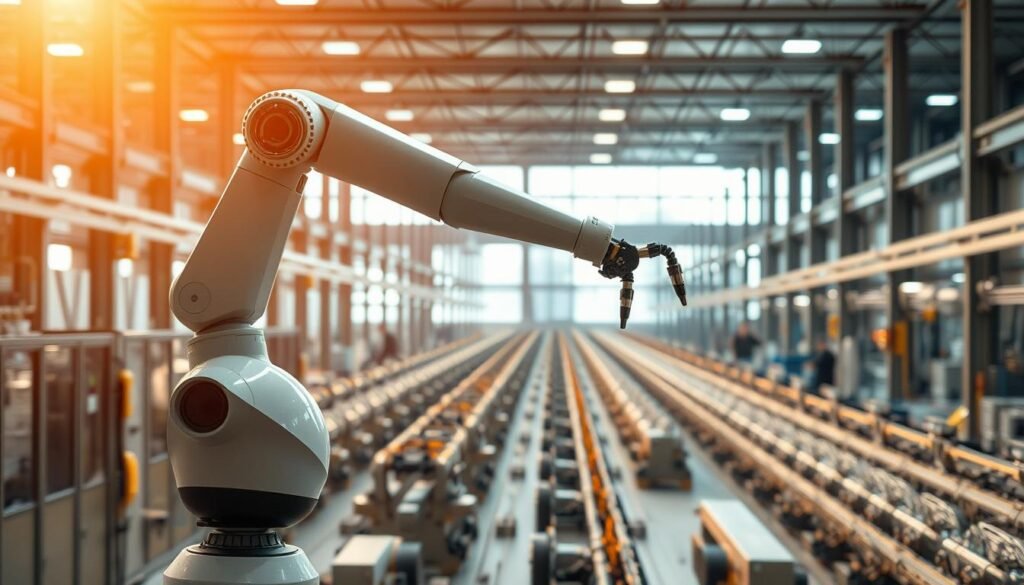
The cobots revolutionized human-machine collaboration in modern industry, offering an innovative approach to industrial automation. Unlike traditional robots, these devices have been specifically designed to work side by side with human professionals, ensuring safety at work e operational efficiency.
The main characteristics of cobots include:
- Advanced motion detection sensors
- Ability to adapt to different tasks
- Ergonomic and safe design
- Intuitive and flexible programming
In Brazilian industry, the cobots are transforming production processes in various sectors. They allow workers to carry out more complex and strategic tasks, while robots perform repetitive and precise functions.
A safety at work is a fundamental aspect of implementing cobots. These collaborative robots have immediate stop systems and can detect human presence, significantly reducing the risk of accidents.
Cobots represent a new era in industrial automation, where technology and humanity work in perfect harmony.
Companies that invest in cobots experience substantial gains in productivity, quality and ergonomics, demonstrating that the human-machine collaboration is the future of modern manufacturing.
Artificial Intelligence and Machine Learning in Automation
The technological revolution is completely transforming industrial processes. The integration of artificial intelligence into industry has enabled significant advances in robotic systems, creating new possibilities for intelligent automation.
The machine learning are revolutionizing the way companies implement automated solutions. You can see different implementation strategies:
- Predictive maintenance analysis
- Process optimization productive
- Autonomous decision-making
Practical Applications of AI
The autonomous systems represent an impressive technological leap forward. They enable machines to learn and adapt quickly, increasing the operational efficiency in various industrial sectors.
Development of Autonomous Systems
The implementation of machine learning on production lines allows robots to perform increasingly complex tasks, reducing human error and increasing productivity.
Future of Intelligent Automation
As tendências atuais indicam que a IA continuará expandindo suas fronteiras, criando sistemas cada vez mais sofisticados e capazes de aprender autonomamente, transformando radicalmente os ambientes industriais.
Digital Transformation through Robotics

A industrial digitalization is revolutionizing the way companies operate, with robotics playing a key role in this transformation. Modern technologies are enabling industries to create smarter, more connected production environments.
A robotic automation is enabling companies to achieve impressive levels of efficiency and innovation. Through systems integration IoTindustries are creating truly integrated production ecosystems.
- Digitization of production processes
- Systems integration intelligent
- Real-time connectivity
A connected industry is no longer a futuristic concept, but a current reality. Companies that adopt these technologies are gaining significant competitive advantages, completely transforming their business models.
A digital transformation is not about technology, but about how technology can improve the business experience.
The main benefits of digital transformation through robotics include:
- Increased productivity
- Reduced operating costs
- Improved decision-making
- Greater production flexibility
Brazilian companies are rapidly embracing this technological revolution, investing in robotic solutions that transform their industrial processes and prepare them for the challenges of the future.
Safety and Efficiency in Industrial Automation
Industrial automation has revolutionized working environments, radically transforming the way companies operate. In the age of advanced technology industrial safety has become a fundamental pillar for guaranteeing the protection of workers and the efficiency of production processes.
Implementing modern robotic systems requires a strategic approach that prioritizes safety and performance. Here are some crucial aspects:
Essential Security Protocols
- Identification of risk zones
- Installation of physical barriers and sensors
- Specialized training for operators
- Implementation of emergency stop systems
Robotic certifications required
The robotic certifications ensure that the equipment meets the strictest safety standards. Some key certifications include:
| Certification | Objective |
|---|---|
| NR-12 | Safety in machinery and equipment |
| ISO 10218 | Safety requirements for industrial robots |
| ISO 13849 | Safety-related control systems |
Predictive Maintenance: Intelligent Prevention
A predictive maintenance represents a significant advance in the management of robotic systems. Using sensors and data analysis, it is possible:
- Predict failures before they occur
- Reduce unscheduled downtime
- Increase the useful life of equipment
- Minimize maintenance costs
Investing in security and advanced technologies is not just a matter of compliance, but a smart strategy to protect people, processes and business results.
Implementation of Robotic Systems
The implementation of robotic systems represents a strategic challenge for companies seeking to modernize their industrial processes. O automation planning requires a careful and meticulous approach to ensure efficient results.
When starting your automation project, you need to consider a few fundamental steps:
- Carry out a complete diagnosis of current processes
- Identify potential areas for systems integration
- Assess the technical capacity of the current team
- Define budget and implementation schedule
The integration of robotic systems requires detailed technical planning. Your company must be prepared to adapt existing infrastructures and ensure compatibility between new equipment and traditional processes.
O robotics training is crucial to the success of the implementation. Investing in training professionals allows for a smoother transition and reduces internal resistance.
| Stage | Description | Estimated time |
|---|---|---|
| Diagnosis | Analysis of industrial processes | 30-45 days |
| Planning | Defining an automation strategy | 45-60 days |
| Implementation | Installation of robotic systems | 60-90 days |
| Training | Team training | 30-45 days |
Choosing suppliers who specialize in industrial automation is essential. Look for partners with expertise proven, consistent portfolio and qualified technical support.
Trends and Innovations in Automation
Industrial automation is constantly evolving, driven by technological advances that promise to completely transform production processes. New horizons are opening up with the development of advanced robotics, nanotechnology e quantum computing, setting the stage for an unprecedented technological revolution.
New Emerging Technologies
Emerging technologies are redefining the limits of industrial automation. A advanced robotics enables increasingly intelligent and adaptable systems, capable of performing complex tasks with impressive precision.
- Nanotechnology revolutionizes micromanufacturing processes
- Quantum computing increases processing capacity
- More sophisticated autonomous robotic systems
Prospects for the future
The next few years should see deeper integration between technologies such as artificial intelligence, advanced robotics e nanotechnology. These innovations promise to take industrial efficiency to unimaginable heights.
Technology is not just about machines, but about enhancing human potential.
| Technology | Expected Impact | Time Horizon |
|---|---|---|
| Advanced Robotics | Process automation complex | 2-5 years |
| Nanotechnology | Microscopic precision | 5-10 years |
| Quantum Computing | Exponential processing | 10-15 years |
Get ready for a fascinating journey towards a future where automation will not just be a tool, but a true strategic partner for Brazilian industry.
ROI and Economic Benefits of Automation
Industrial automation revolutionizes operational efficiency of companies, offering impressive economic benefits. A recent study revealed surprising data on the return on investment in robotic systems.
When carrying out a cost-benefit analysis companies can identify strategic opportunities for robotic implementation. The results are significant:
- Reduction of operating costs by up to 75%
- Increased productivity in 75%
- Return on investment of 321% in less than 12 months
The operational efficiency achieved by automation is not just about numbers. It transforms processes, eliminates bottlenecks and allows teams to focus on strategic tasks with greater added value.
Robotic technology is not a cost, but an investment in your company's future.
Companies that invest in intelligent automation succeed:
- Improving product quality
- Reducing human error
- Increasing competitiveness in the market
The decision to implement robotic systems requires careful evaluation, but the economic benefits are clear and measurable.
Conclusion
Digital transformation through robotics represents much more than a simple technological change. It is a revolution that is completely redesigning industrial processes in Brazil. A technological adaptation has become a crucial element for companies wishing to remain competitive in the global market.
Investing in continuous innovation is no longer an option, but a strategic necessity. Organizations that quickly grasp the potential of industrial automation will have significant advantages. Your the future of automation will depend on the ability to integrate new technologies efficiently and intelligently.
Brazilian companies need to be prepared for this transformation. Developing skilled teams, investing in training and creating a culture of constant learning will be key to harnessing the full potential of modern robotics. Innovation will be the main competitive differentiator in the coming decades.
The journey towards full automation will require courage, strategic vision and a willingness to experiment. Is your company ready for this challenge? The time is now to begin this digital transformation that promises to completely revolutionize Brazilian industry.
FAQ
A: Industrial robotics refers to the use of automated robots to perform repetitive, precise and complex tasks in production environments. These robotic systems are designed to increase efficiency, productivity and quality in manufacturing processes.
A: The main benefits include increased productivity, reduced operating costs, improved product quality, greater safety in the working environment and consistent precision in operations.
A: Cobots (collaborative robots) are robotic systems designed to work directly alongside humans, sharing the same workspace. They are safer and more flexible than traditional industrial robots, allowing for closer and more collaborative interaction.
A: Artificial Intelligence powers robotic systems, enabling autonomous learning, intelligent decision-making, maintenance prediction and continuous optimization of industrial processes.
A: The automotive, electronics, food and beverage, pharmaceutical and metallurgy sectors are the main adopters of robotic technologies in the Brazilian industrial context.
A: The investment varies significantly depending on the complexity of the system, but generally offers return on investment (ROI) between 1-3 years, with long-term benefits in efficiency and productivity.
A: Safety is guaranteed through strict protocols, emergency stop systems, advanced sensors, appropriate training and compliance with industrial safety standards.
A: Not completely. The trend is towards complementarity, where robots take on repetitive and dangerous tasks, while humans focus on activities that require creativity, strategy and complex decision-making.
A: The main trends include more intelligent and autonomous robots, integration with Internet of Things (IoT), systems with greater learning capacity, nanotechnology and quantum computing.
A: Companies must invest in staff training, continuous technological updating, partnerships with research centers, a culture of innovation and strategic planning for integrating new technologies.






 Portuguese
  English