
How AI is Transforming the Music Industry
How AI is Transforming the Music IndustryHave you ever thought about how technology is shaping the future of music?
From the phonograph to streaming platforms, each advance has brought significant changes. Now artificial intelligence is at the heart of this transformation, redefining how we create, produce and consume music.
Imagine um mundo onde algoritmos compõem melodias, ferramentas de IA masterizam faixas em segundos e plataformas personalizam playlists com base no seu gosto musical.
This isn't science fiction, it's the reality of industry music today. But how does this affect artists, producers and listeners?
In this article, you'll find out how artificial intelligence is revolutionizing musicfrom creation to distribution. Get ready to explore a universe where technology and art meet, opening doors to new possibilities and challenges.

Introduction to the AI Revolution in Music
The history of music is marked by innovations that have redefined its production and consumption. From the first instruments to synthesizers, each advance has brought new possibilities to the music industry. creation musical.
Today, we are facing a new revolution: the artificial intelligence.
Historical context of technological innovations in the music industry
In the 1960s, synthesizers emerged as a tool revolutionary, allowing the creation of sounds never heard before.
In the 1980s, sampling transformed the productionallowing artists reusing excerpts from existing songs. These innovations prepared the ground for the arrival of artificial intelligence.

According to Ana Clara Ribeiro, a specialist in music technology, "each new tool redefines the role of artist and the way music is created".
This transition between traditional and technological methods is essential to understanding the impact of AI on music industry.
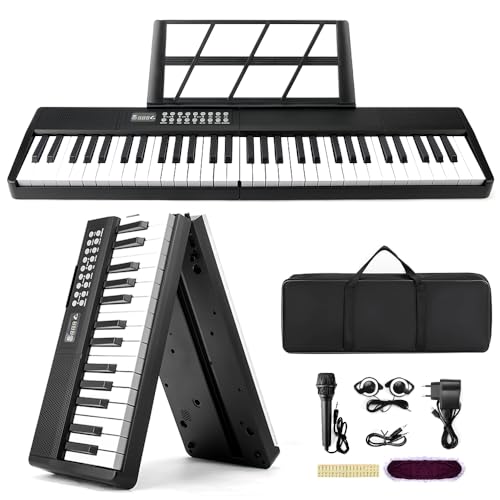
- 🎈- UNLIMITED CONNECTIVITY - This real keyboard The 61-key full-size musical is made of high quality materials and...
- 🎈- TONES AND RHYTHMS - The 61-key piano has two built-in stereo speakers that provide 200 tones, 200 rhythms, 70 ...
- 🎈- MULTIFUNCTIONAL - This digital piano features master volume/subvolume/tempo controls, one-finger chords, a...

The arrival of artificial intelligence and its first impacts
A artificial intelligence arrived as a tool powerful, capable of composing melodies, mastering tracks and even customizing playlists.
Thiago Melo, music producer, says that "AI is not a substitute for artistbut expands its possibilities of creation“.
The first impacts are already visible. A production music has become more accessible, allowing new talents to explore their creativity.
However, this also raises questions about authenticity and the role of the artist in music industry.
| Year | Innovation | Impact |
|---|---|---|
| 1960 | Synthesizers | Creating new sounds |
| 1980 | Sampling | Reuse of musical excerpts |
| 2020 | Artificial Intelligence | Automation and personalization |
How AI is Transforming the Music Industry
Technology is opening up new avenues for music creation and production. Today, platforms innovations are already revolutionizing shape like the musicians work, offering tools that expand their creative possibilities.
Practical examples in music creation and production
One of platforms The best known is Magenta, developed by Google. It uses algorithms machine learning to help musicians composing melodies and arrangements of shape innovative.
Thiago Melo, music producer, shares: "Magenta allowed me to explore sounds that I would never have imagined on my own."
Another example is OpenAI's MuseNet, which generates music in a variety of styles, from classical to pop. This platform is an ally for those looking to try out new forms creation.
"It's like having a musical partner who never tires," jokes Ana Clara, a composer.
A experience of musician is also enriched by tools such as LANDR, which uses algorithms to master tracks in minutes. This democratizes access to high-quality production, allowing independent artists to achieve a professional sound.
| Platform | Function | Benefits |
|---|---|---|
| Magenta | Composition | Increases creativity |
| MuseNet | Music generation | Experimenting with styles |
| LANDR | Mastering | Professional quality |
These platforms not only optimize the work of musiciansbut also transform the shape how music is created and consumed. To find out more about how artificial intelligence is revolutionizing other sectors, check out our full article.
AI tools in music production
The evolution of music production tools is redefining the music scene. industry. With intelligence artificial, processes that used to take hours are now carried out in minutes, maintaining quality and respecting the copyright.
DAWs and the automation of recording and mixing processes
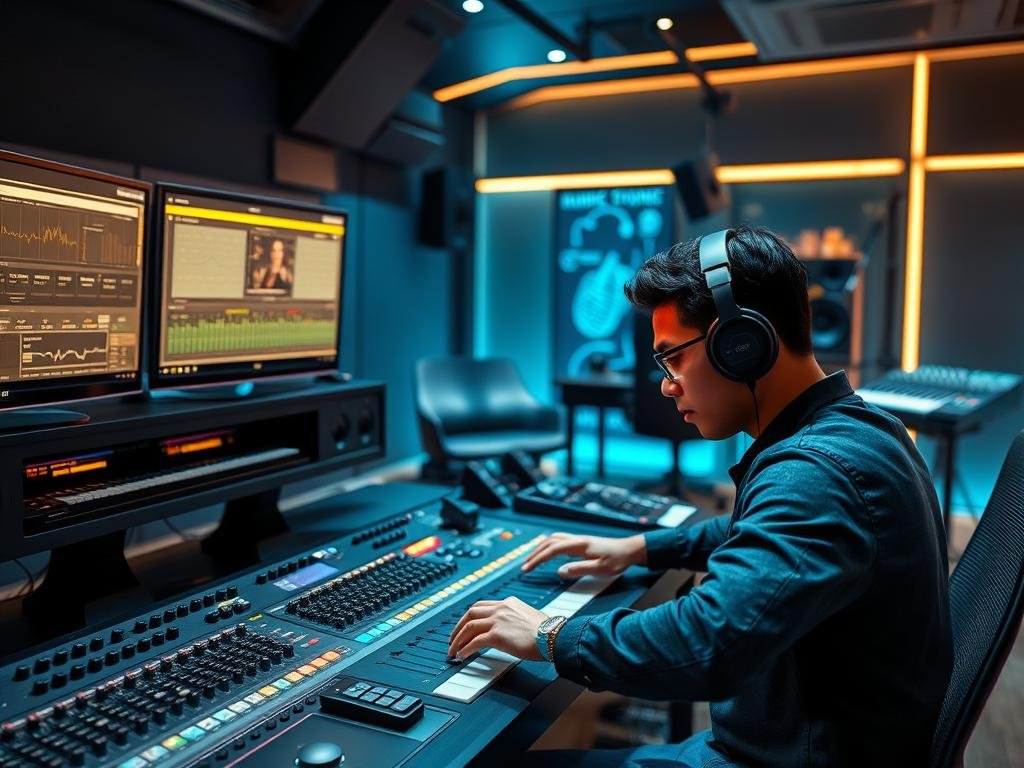
Modern DAWs (Digital Audio Workstations) are incorporating intelligence to automate tasks such as recording and mixing.
Thiago Melo, music producer, shares: "With tools like iZotope, I can fix audio problems in seconds, which used to take hours."
This automation not only saves time, but also allows artists to focus on creationpreserving the artistic essence.
In addition technology of streaming is integrated with these tools, making it easier to distribute the tracks.
Collaborative software such as MuseNet and Magenta
Platforms like MuseNet and Magenta are revolutionizing the way musicians work. MuseNet, for exampleMagenta helps to compose melodies and arrangements.
Ana Clara, a composer, says: "Magenta has broadened my creativity, allowing me to explore sounds I never imagined."
These tools combine automation with human control, ensuring that the rights artists are respected.
| Tool | Function | Benefits |
|---|---|---|
| iZotope | Audio correction | Saving time |
| MuseNet | Music generation | Experimenting with styles |
| Magenta | Composition | Expanding creativity |
These tools not only optimize the work of musicians, but also transform the way music is created and consumed. A intelligence artificial is opening doors to new possibilities, while maintaining respect for the copyright and artistic essence.
Avatars and Virtual Artists: The New Face of K-Pop
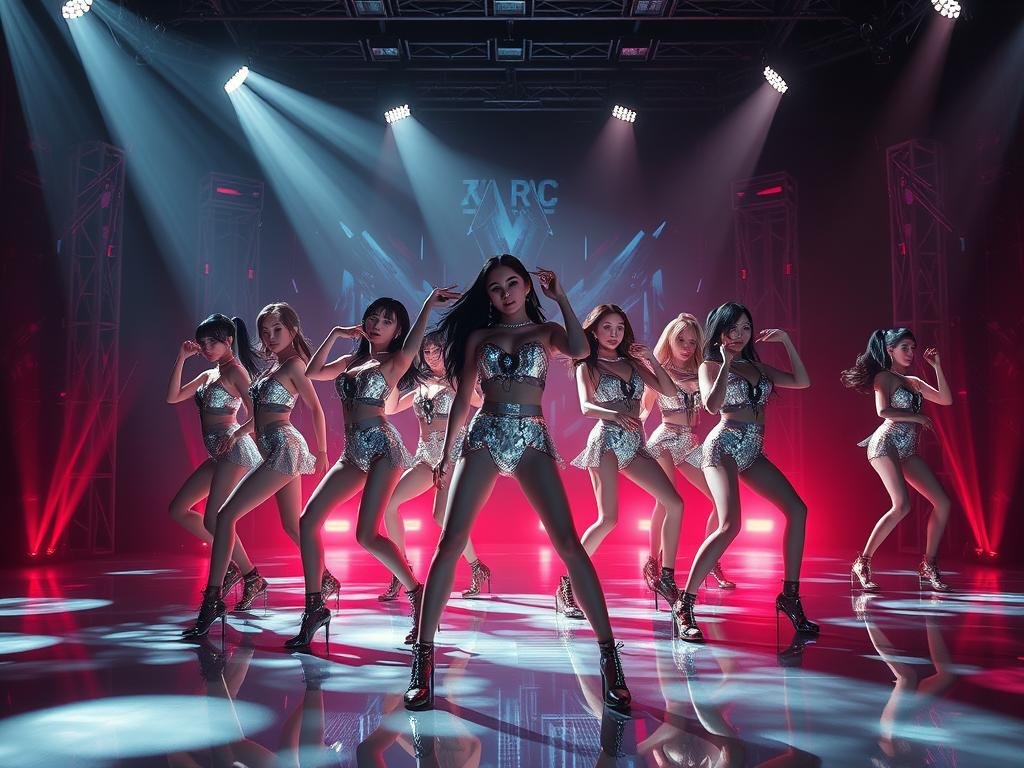
K-Pop is reinventing itself with the help of technology, bringing avatars and virtual artists to the stage. This innovation not only redefines the userbut it also opens doors to a future where creativity and technology merge.
Creating avatars and characters through deep learning
Groups like Eternity, Superkind and MAVE are using deep learning to create avatars that look real.
These virtual characters are designed to sing, dance and interact with the public, offering a new form of content musical.
According to experts, this innovation is a advance significant in the industry. "The technology allows virtual artists to be as engaging as humans, but with unprecedented creative flexibility," explains a Korean producer.
Challenges of acceptance and interaction with the public
Despite advance acceptance of these virtual artists still faces challenges. Many fans question the authenticity and emotional connection that these avatars can offer.
One user shared: "It's fascinating to see technology in action, but I miss the human interaction that real artists provide." This feedback shows the importance of balancing innovation with the public's expectations.
O future of K-Pop with virtual avatars is promising, but it depends on the ability to integrate technology and emotion in a harmonious way.
This innovation not only transforms the way we consume contentbut also redefines the role of user in the musical experience.
Impacts on Creativity and Artistic Essence
Musical creativity is undergoing a significant transformation with the use de novas tecnologias. A automação e os algoritmos estão revolucionando o process of creation, but this raises important debates about the preservation of artistic authenticity.
Debates on preserving authenticity in music creation
One of the main questions is whether technology can preserve the human essence in the composition. Ana Clara Ribeiro, a specialist in music technology, says:
"Automation can optimize processBut the human touch is irreplaceable in art."
Thiago Melo, music producer, adds: "The use of automated tools should be a complement, not a replacement. Genuine creativity comes from the experience and emotion of the artist."
O process creative can be affected by use excessive use of technological tools. Companies are seeking to balance innovation and authenticity, ensuring that technology amplifies rather than diminishes artistic expression.
| Aspect | Impact | Solution |
|---|---|---|
| Automation | Reduced production time | Integration with human creativity |
| Algorithms | Personalizing playlists | Maintaining authenticity |
| Tools | Democratization of production | Respect for copyright |
The challenge is to find a balance between innovation and preserving genuine creativity. Companies and producers are targeting use technology to complement, not replace, human art.
Ethical and Copyright Issues
The evolution of technology brings with it ethical challenges that need to be discussed. In world of music, the artificial intelligence is redefining not only creation, but also the rights and authenticity of works.
How to protect person of the artist in a scenario where algorithms can replicate his style?
Challenges in recognizing personality rights
One of the biggest dilemmas is the recognition of the rights of person. With AI tools capable of imitating voices and stylesHow can you guarantee that the original artist is credited? Thiago Melo, music producer, warns:
"Technology can be an ally, but also a threat to the artist's identity."
In Brazil, bills such as PL 4025/23 seek to regulate the use of AI in order to protect moral and copyright rights.
A need of specific laws is clear, especially in a world where the streaming platforms play music generated by algorithms.
Regulations and bills in Brazil and internationally
The discussion about copyright is not limited to Brazil. In countries like South Korea, guidelines are already in place to ensure that technology respects the authenticity of works.
Ana Clara Ribeiro, a specialist in music technology, says: "Regulation is essential to balance innovation and protection."
On the global stage, the need clear laws is urgent. Bill 2338 in Brazil, for example, establishes criteria for the use of works in AI systems, ensuring that artists' rights are preserved.
This is a discussion that goes beyond borders, involving the world whole.
Finding a balance between innovation and protection is the big challenge. A need The need for specific regulations is obvious, but it is also crucial that laws keep pace with the speed of technological change.
Thus, the essence of person and the artist can be preserved, even in a world increasingly digital.
Technological Innovations in Streaming Platforms
Streaming platforms are revolutionizing the way you discover and consume music. With advanced algorithms, they offer a personalized experience, tailored to your taste in music.
This not only facilitates the discovery of new tracksbut also benefits producers and independent artists.
Recommendation algorithms and personalization for the listener
Platforms such as Spotify and YouTube use machine learning to analyze your listening habits. Based on this data, they create personalized playlists, like Spotify's "Discover Weekly".
According to a report, 80% of users discover new music through these recommendations.
This technology not only improves the listener's experience, but also helps artists reach new audiences.
"Algorithms democratize access to music, allowing independent talents to be discovered," explains Ana Clara, a specialist in music technology.
In addition, platforms such as TikTok are transforming the way in which tracks gain popularity. Songs that go viral on these networks often enter the global charts, showing the power of the integration between technology and music creation.
| Platform | Functionality | Benefits |
|---|---|---|
| Spotify | Personalized playlists | Discovering new artists |
| YouTube | Recommendations based on history | Extended musical range |
| TikTok | Viralization of music | Popularization of tracks |
These innovations are transforming the sectormaking music more accessible and diverse. For producersThis means new opportunities for growth and visibility. For you, a richer, more personalized musical experience.
Mastering and Distribution: The New Era in Music Production
Music mastering and distribution are entering a new era, driven by technology. With the artificial intelligenceprocesses that used to take hours can now be carried out in minutes, maintaining studio quality and opening up new ways of working. opportunities for artists and producers.
Advances in digital mastering through AI
Platforms like LANDR are revolutionizing mastering. Using algorithms advanced, they adjust the audio automatically, guaranteeing professional sound.
Thiago Melo, music producer, shares: "AI has allowed me to finish tracks in minutes, something that used to take days."
This technology not only saves time, but also democratizes access to high-quality production. Independent artists can now compete on equal terms with major record labels, thanks to the efficiency of artificial intelligence.
Royalty management and the transformation of music distribution
Music distribution is also being transformed. Platforms such as ONErpm use algorithms to manage royalties more efficiently. This ensures that artists receive their royalties fairly and transparently.
Ana Clara Ribeiro, a specialist in music technology, says: "AI is redefining the way music is distributed and monetized. This is a big opportunity for future music.”
In addition voice of the artist is preserved, even in automated productions. This is crucial for maintaining authenticity and musical identity.
To find out more about how Artificial Intelligence in the Music Industry is revolutionizing other sectors, check out our full article.
Technology is opening doors to a future music more accessible and fair. With AI, mastering and distribution become more efficient, benefiting both the listener as the artist.
This is the new era of music production, where technology and creativity meet.
Conclusion
Music is going through a revolution, where the technology and creativity are way unique. Throughout this article, we explore how innovations are redefining the processes of creation, production and distribution. A creativity is still essential, even with the advance of technological tools.
O work between artists and programmers opens up new possibilitiesallowing music to reach unprecedented heights.
However, it is crucial to balance innovation with authenticity, ensuring that the public remain emotionally connected to the works.
Think about the future of music and how you can adapt to these changes. Keeping up with trends with a critical and innovative eye is the key to making the most of them. possibilities that technology offers.
FAQ
Q: How is artificial intelligence changing music creation?
A: AI is revolutionizing music creation by offering tools that help with composition, production and even mixing. Platforms like MuseNet and Magenta allow musicians to experiment with new styles and ideas quickly and intuitively.
Q: What are the impacts of AI on music distribution?
A: AI is transforming music distribution by optimizing processes such as royalty management and digital mastering. In addition, streaming algorithms personalize recommendations for listeners, increasing the reach of tracks.
Q: Can AI replace human artists?
A: AI doesn't replace artists, but it can be a powerful tool to amplify creativity. Virtual avatars, such as those used in K-Pop, are examples of how technology can complement art, but the human essence is still irreplaceable.
Q: What are the ethical challenges of using AI in music?
A: One of the main challenges is the protection of copyright and personality rights. Regulations are still being developed, both in Brazil and internationally, to ensure that the use of AI is fair and transparent.
Q: How do streaming platforms use AI?
A: Platforms like Spotify and Apple Music use AI algorithms to analyze user behavior and offer personalized recommendations. This improves the listener experience and helps artists reach new audiences.
Q: Can AI help with music production?
A: Yes, AI is already used in DAWs (Digital Audio Workstations) to automate processes such as recording, mixing and mastering. This speeds up production and allows producers to focus more on creativity.
Q: What are virtual avatars in music?
A: Virtual avatars are characters created with technologies such as deep learning that interact with the public and even produce music. They are popular in genres such as K-Pop, but still face acceptance challenges.
Q: Does AI affect authenticity in music?
A: This is an ongoing debate. While some see AI as a threat to authenticity, others believe it can broaden creativity and bring new possibilities to the music industry.
Source links
- Artificial Intelligence in the Music Industry
- Learn how artificial intelligence is transforming the music industry
- The use of artificial intelligence in musical composition | SUNSET MUSIC
- The Impact of AI on Music Creation - Music4ll
- Generative artificial intelligence and the copyright frontier
- AI in the Real World: Uncover the Impacts of Artificial Intelligence on Everyday Life




 Portuguese
  English