

Have you ever imagined being completely immersed in a virtual worldwhere everything seems real?
A virtual reality is a technology revolution that is changing the way we interact with the digital world.
It creates environments immersive that trick our senses, transporting us to experiences that are impossible in real life.
With the evolution of virtual realityyou can explore new worlds and discover new experiences.
All About Virtual Reality: What It Is and How It Works
Have you ever wondered what virtual reality is and how it works? Virtual reality is a technology that is revolutionizing the way we interact with the digital world.
In this section, we'll explore the basic concepts and differences between virtual, augmented and 3D reality.
Definition and Basic Concepts
A virtual reality (VR) is a technology that creates a simulated, completely digital environment that can be experienced in an immersive way.
When using devices such as VR goggles or headsets, you are isolated from the real worldwith their vision completely replaced by a digital universe. This allows for a unique and interactive experience.
VR technology involves several disciplines, including computer graphics, image processing and voice recognition.
VR devices are designed to provide an immersive experience, with sensors that detect the user's movements and adjust the display in real time.
Differences between Virtual, Augmented and 3D Reality
It is essential to understand the differences between virtual reality, augmented reality (AR) and 3D technology to understand the potential of each. Here are some of the main differences:
- In virtual realityYou are completely cut off from the real world, with your vision completely replaced by a digital environment through glasses or headsets.
- A augmented reality (AR) does not replace the real world, but adds digital elements to it. Examples include Instagram filters and apps like Pokémon GO, where you see the real world with virtual objects superimposed.
- 3D technology creates the illusion of depth in flat images, but it doesn't offer the same immersion or interactivity as virtual reality.
By understanding these differences, you can make the most of the possibilities offered by each technology.
While virtual reality creates completely new worlds, the augmented reality enhances the real world with digital information, and 3D technology simulates visual depth.
The Historical Evolution of Virtual Reality
From the first flight simulators to modern VR headsets, virtual reality has come a long way. Over time, the virtual reality has passed important milestones that have revolutionized its development and application.
The First Steps in VR Technology
In 1950, the US Air Force was already building flight simulators, one of the first practical uses of simulated environments.
"Simulation technology was ahead of its time," as one expert points out. In 1958, Philco developed a pair of remote cameras and the prototype of a helmet with monitors that allowed the wearer to feel a sense of presence when inside an environment.
A breakthrough came in 1962 with Morton Heilig's Sensorama, which combined 3D movies, stereo sound, mechanical vibrations, aromas and air moved by fans, creating a multi-sensory experience.
Important Milestones in the Development of Virtual Reality
O development of digital gloves between 1977 and 1982 by the University of Illinois marked the beginning of tactile interaction with virtual environments.
In 1987, VPL Research Inc. began selling digital helmets and gloves, making the technology more accessible.
The launch of the Oculus Rift in 2012, followed by the acquisition of the company by Facebook for US$2 billion in 2014, represented a turning point that popularized the virtual reality for the average consumer.
Today, you can experience virtual reality in an accessible and immersive way, thanks to these advances.
How Virtual Reality Technology Works
Você já se perguntou como a realidade virtual consegue criar experiências tão imersivas? A tecnologia por trás da realidade virtual é fascinante e envolve uma combinação de hardware e software avançados para criar ambientes virtuais interativos.
Essential Components of a VR System
A virtual reality system is made up of several essential components. O hardware includes devices such as VR headsets, motion controllers, and headsets for spatial audio.
O software is equally crucial, as it is responsible for rendering the graphics in real time and processing user interactions.
| Component | Description |
|---|---|
| VR headset | Display device that you wear on your head to visualize the virtual environment. |
| Motion Controllers | Devices that track your hand movements, allowing you to interact with virtual objects. |
| Headphones | They provide spatial audio for a more immersive experience. |

Aimed at the reader who wants to have their first contact with or expand their knowledge about the use of Virtual Reality (VR) and Augmented Reality (AR), this book presents a range of information about these technologies, which are considered important tools for the fields of medicine, education, architecture, engineering, among others. Divided into four chapters, the book presents the functional principles of VR and AR, their applications and their benefits. Using accessible and didactic language, it shows how these technologies can be used as auxiliary tools in our professional tasks, as well as in the teaching/learning process in various fields of science. Three important platforms for projects are also highlighted.
The Immersion and Interaction Process
Immersion in virtual reality depends on the system's ability to convince your brain that you are actually present in the virtual environment.
O 3D spatial audio plays a crucial role in this, allowing you to identify the direction and distance of sounds.
Interaction takes place via hand controllers or gloves with sensors, allowing you to manipulate virtual objects.
A latencyor response time, is critical for immersion. The shorter the delay between your movements and the visual response, the more convincing the experience.
Your brain is naturally inclined to accept the illusion of reality when multiple senses receive coherent and synchronized stimuli.
Main Virtual Reality Devices for Smartphones
If you're looking to enter the world of virtual reality without spending too much, virtual reality equipment for smartphones is a great choice.
Google Cardboard and Daydream View
Google Cardboard is one of the most accessible and simple options for experiencing virtual reality. It works with most smartphones and offers an introduction to the VR world.
Daydream View, on the other hand, is a slightly more advanced option, offering a more immersive virtual reality experience with included controls.
Samsung Gear VR
The Samsung Gear VR is a virtual reality device developed by Samsung in partnership with Oculus. It offers a high-quality VR experience, compatible with certain high-end Samsung smartphone models.
Other affordable options
In addition to the options from the big companies, you can find a number of affordable virtual reality devices for smartphones on the market.
The VR Box is a popular example of an inexpensive headset that works with virtually any smartphone and offers focal length and interpupillary distance adjustments.
Xiaomi, known for its cost-effective products, offers the VR Play II, which combines quality materials with an affordable price.
Brazilian brands such as Multilaser and Aquário also offer options such as the Warrior JS080 and VRG-01, facilitating access to technology in the domestic market.
These devices generally share similar characteristics: they are lightweight, have adjustable lenses and use your smartphone as a screen and processorThey are ideal for those who want to experience virtual reality without a large initial investment.
Advanced VR Devices for Computers

Virtual reality (VR) devices for computers are revolutionizing the way we interact with the digital world.
With the ability to provide immersive and interactive experiences, these devices are becoming increasingly popular among gamers, professionals and technology enthusiasts.
Oculus Rift and Meta Quest
Oculus, acquired by Facebook, was one of the pioneers in VR technology for computers with the Oculus Rift. This device offered a high-quality VR experience, with high-resolution screens and precise tracking.
The Meta Quest, on the other hand, represents an evolution in the Oculus product line, offering an autonomous VR experience without the need for a computer connected.
HTC Vive and Valve Index
HTC Vive, developed in partnership with Valve Corporation, has revolutionized virtual reality by introducing full room-scale tracking since its initial launch.
This system allows you to physically walk within a delimited space and see your movements perfectly replicated in the virtual world.
Valve Index represents the state of the art in VR for PC, with high-resolution screens, an enlarged field of view and the revolutionary "Knuckles" controllers that individually track each finger.
These premium devices require a powerful computer with high-performance graphics cards, representing the cutting edge of VR technology available to consumers.
Independent Virtual Reality Headsets
You can immerse yourself in virtual reality experiences without the need for a powerful computer with the stand-alone headsets.
These devices are becoming increasingly popular due to their convenience and ability to provide high-quality immersive experiences.

Meta Quest 2 and Quest Pro
Meta, formerly known as Facebook, has been one of the main companies pushing virtual reality technology with its products.
O Meta Quest 2 is one of the most popular headsets, offering a high-quality virtual reality experience without the need for a PC.
The Quest Pro is a more advanced version, with features such as eye-tracking and higher resolution.
When exploring the options for stand-alone virtual reality headsets, you may find that Meta offers a range of advanced features that make the experience even more immersive.
To find out more about how virtual reality is being used in different sectors, you can visit this article on the use of VR headsets in educational environments.
Pico and Other Autonomous Devices
In addition to Meta's products, the market for autonomous virtual reality devices is expanding rapidly with options from a number of companies.
A Picoacquired by ByteDance (the company that owns TikTok), offers headsets such as the Pico 4 Pro with an impressive resolution of 2160×2160 per eye and advanced eye-tracking technologies.
HTC and Lenovo are also present in this market, with devices such as the HTC Vive Focus3 and Lenovo ThinkReality VRXwhich offer high-quality virtual reality experiences.
These devices are democratizing access to the virtual world, making the experience more accessible and convenient for everyone.
Controllers and Accessories for Complete VR Experiences
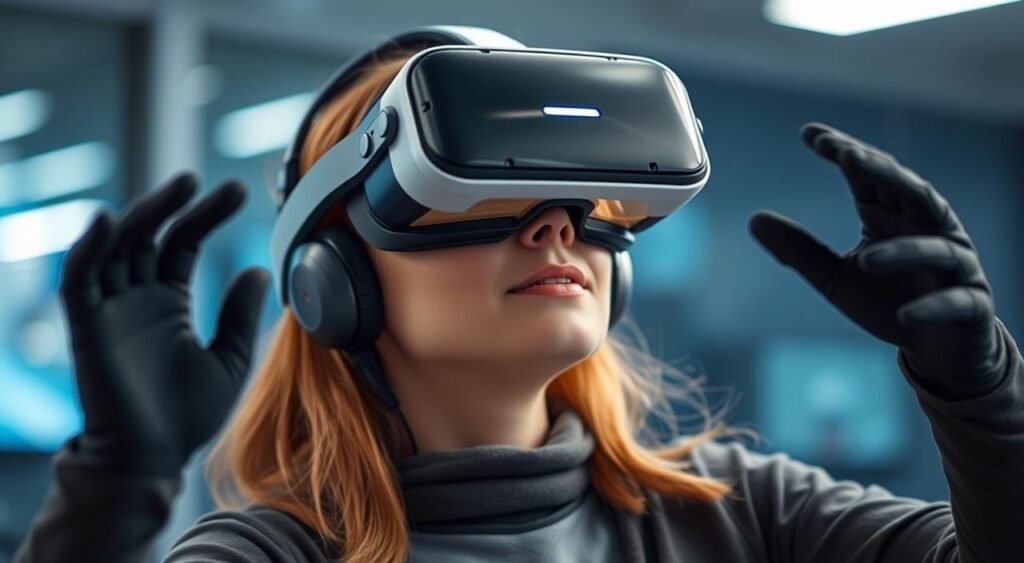
In addition to the headset, there are various accessories that can enhance your virtual reality experience. Controllers and accessories are essential for a more immersive and realistic interaction with the virtual environment.
Haptic Gloves and Motion Sensors
Haptic gloves and motion sensors allow you to interact with virtual objects in a more natural way. With these devices, you can feel textures, manipulate objects and perform complex actions within the virtual environment.
An example of advanced technology are haptic gloves that provide tactile feedback, allowing you to feel the resistance and texture of virtual objects.
VR Movement Platforms and Treadmills
VR motion platforms and treadmills are designed to solve one of virtual reality's biggest challenges: allowing you to physically move around large virtual spaces while remaining in a limited area in the real world.
Devices such as KatVR Kat Walk and Virtuix Omni One allow you to walk naturally in any direction, with your steps being translated into movement in the game or application.
In addition, solutions such as VirZoom turn an exercise experience into a virtual adventure by combining an exercise bike with special controls.
The Roto VR chair offers an immersive experience for vehicle simulations, rotating 360 degrees in sync with your actions in the virtual environment.
Another interesting concept is USP's Digital Cave, where the user enters a room with projections on all the walls, creating an immersive environment shared by several people simultaneously.
Virtual Reality Applications in Games and Entertainment
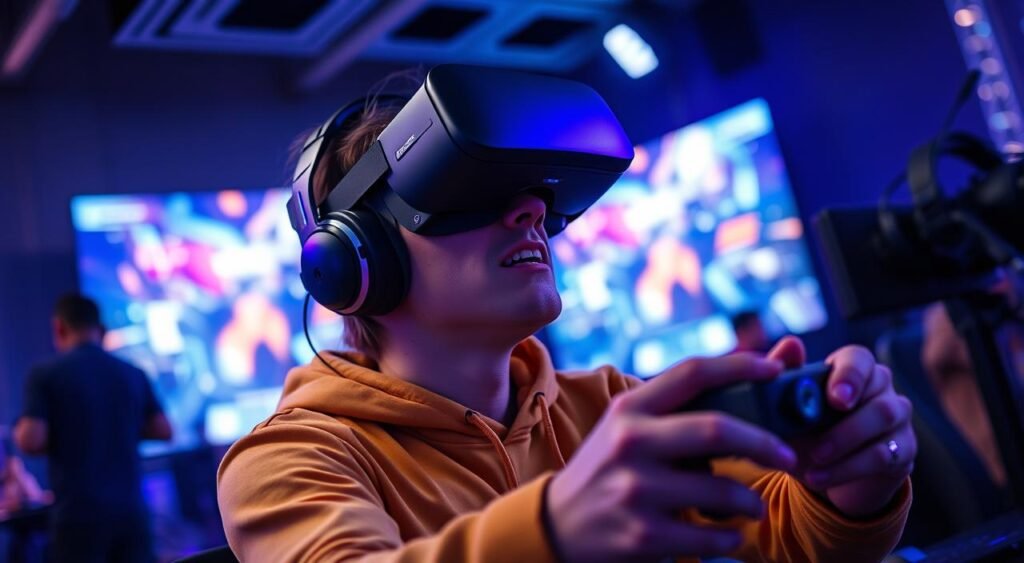
A realidade virtual está revolucionando a forma como você experiencia jogos e entretenimento. Com a capacidade de mergulhar em mundos virtuais, a experiência se torna mais imersiva e interativa.
Immersive Games that Revolutionized the Market
Virtual reality games have been one of the main drivers of the adoption of this technology. Games such as Beat Saber e Half-Life: Alyx offer unique experiences that combine action, adventure and immersion.
In addition, platforms such as Web VR Experiments offer free VR experiences that are accessible even without specialized equipment.
VR Cinema and Entertainment Experiences
In addition to games, virtual reality is transforming the way you consume other types of entertainment, especially cinema and narrative experiences.
Platforms such as Bigscreen VR allow you to watch movies in giant virtual theaters, alone or with friends represented by avatars.
360-degree cinematic experiences put you at the heart of the action, allowing you to look around and explore the scene from any angle, creating a new narrative format.
Film festivals such as Sundance and Tribeca already have sections dedicated to virtual reality experiences, recognizing its potential as a new form of art and entertainment.
Virtual Reality in Education and Professional Training
Virtual reality is revolutionizing the way we learn and train professionally. With the ability to create immersive and interactive environments, VR technology is being adopted in a number of areas to improve the efficiency and safety of training.
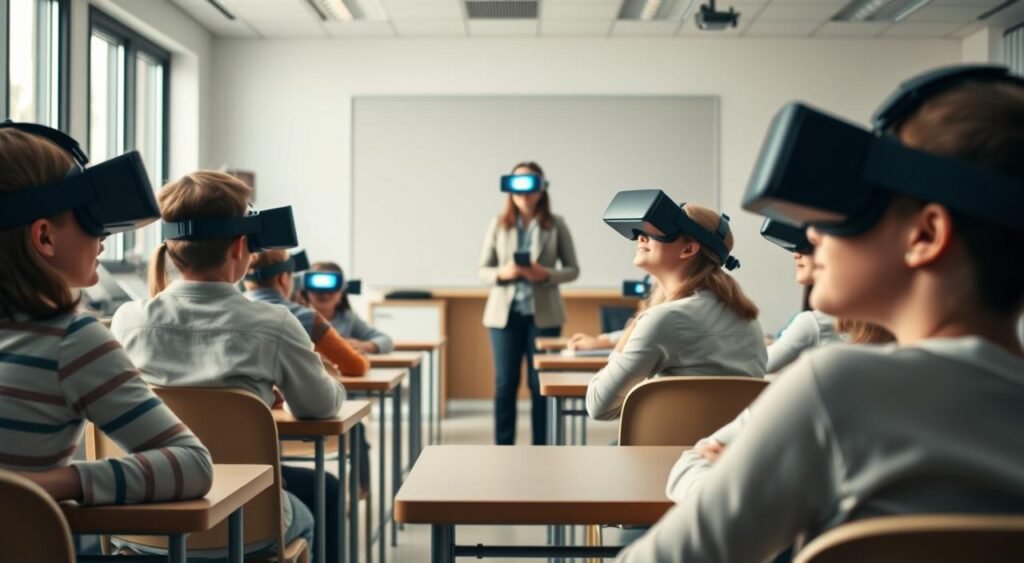
Immersive Learning
Virtual reality transforms learning by providing immersive experiences that simulate real situations. This is particularly useful in areas where practical training is crucial but can be risky or expensive.
For example, healthcare professionals can practice complex surgical procedures in virtual environments, visualizing the anatomy in 3D and repeating operations as many times as necessary, without risk to real patients.
Training Simulators
Virtual reality simulators are revolutionizing professional training in many areas, offering safe practice in high-risk situations.
In aviation, for example, traditional training that previously cost millions of dollars and took 28 weeks can be carried out in just 20 weeks and for a fraction of the cost using VR simulators.
- The use of virtual reality simulators is revolutionizing professional training in many areas.
- Healthcare professionals use virtual reality to practice complex surgical procedures.
- The content of these trainings can be standardized and distributed globally.
By adopting virtual reality for professional training, you are investing in a more efficient, safe and accessible form of learning. This technology not only improves the quality of training, but also reduces costs and increases productivity.
Innovative Applications of Virtual Reality
Virtual reality is revolutionizing many areas with its innovative applications. You can explore new worlds, improve your health and even transform the way you interact with others. people around the world.
Medicine and Rehabilitation
Virtual reality is being used in medicine to treat patients with phobias, PTSD and other psychological conditions. In addition, it helps with physical rehabilitation, allowing patients to exercise more effectively. engaging and fun.
Architecture and Design
In the field of architecture and design, virtual reality allows professionals to create interactive 3D models of buildings and spaces. This facilitates visualization and planning, improving collaboration between stakeholders.
Visit techbytehub.com/reality-enhanced/ to find out more about how technology is advancing.
Virtual Tourism and Remote Events
Virtual tourism is allowing people to explore exotic and historic destinations without leaving home.
Apps like National Geographic Explore VR offer guided experiences in places like Machu Picchu or the Grand Canyon.
In addition, remote events in VR are redefining conferences and concerts, allowing for more natural social interactions.
With these innovations, virtual reality is opening up new possibilities for applications in various sectors, transforming the way we live and interact.
The events virtual, for example, are becoming increasingly popular, allowing people to connect in a more immersive way.

- Transform your reality and do everything you love in totally new ways. Welcome to Meta Quest 3S. Now you can get the Bat...
- Explore thousands of unreal experiences with mixed reality, where you can blend digital objects into the room around you...
- Have more fun with friends in Quest. Whether you're stepping into an immersive game with people from around the world, w...
Conclusion
The virtual reality has ceased to be futuristic and has become a reality in our lives. With constant evolution, new possibilities arise, transforming the way we interact with the digital world and the real world.
From affordable equipment for smartphones to advanced stand-alone systems, the options available today allow you to choose the experience that best suits your needs and budget.
The applications of virtual reality go far beyond entertainment, revolutionizing fields such as education, medicine, architecture and professional training.
As technology continues to evolve, the line between real world and the virtual becomes increasingly tenuous, with experiences more immersive and realistic.
O future of virtual reality promises devices that are lighter, higher resolution and capable of stimulating more senses. experience even more indistinguishable from reality.
To find out more about how virtual reality and augmented reality are transforming various industries, you can visit the article at Sebrae Portal.
With 216 million users expected by 2025 in the gaming sector alone, we are only at the beginning of a revolution that will continue to fundamentally transform the world of gaming. shape how we interact with technology and with each other.
Whether for work, learning or fun, the virtual reality offers possibilities limited only by the imagination, allowing you to experience places, situations and perspectives that would be impossible in the real world. real world.
FAQ
Q: What is Virtual Reality?
A: Virtual Reality is a technology that creates an immersive and interactive environment, simulating a real or fictitious experience.
Q: What are the main differences between Virtual and Augmented Reality?
A: Virtual Reality creates a completely virtual environment, while Augmented Reality superimposes virtual elements onto the real world.
Q: What are the main Virtual Reality devices?
A: The main equipment includes headsets such as Oculus Rift, Meta Quest and HTC Vive, as well as controllers and accessories such as haptic gloves and motion sensors.
Q: How does Virtual Reality technology work?
A: Virtual Reality technology works through components such as high-resolution screens, motion sensors and powerful processors, which work together to create an immersive experience.
Q: What are the applications of Virtual Reality?
A: Applications include games, entertainment, education, professional training, medicine, architecture, design and virtual tourism, among others.
Q: What are the benefits of Virtual Reality in education?
A: Virtual Reality can transform learning with immersive experiences, making it more interactive and effective.
Q: Can I use Virtual Reality with my smartphone?
A: Yes, there are Virtual Reality options for smartphones, such as Google Cardboard and Samsung Gear VR.
Q: What are the main brands of Virtual Reality headsets?
A: Some of the main brands include Oculus, Meta, HTC and Pico.